
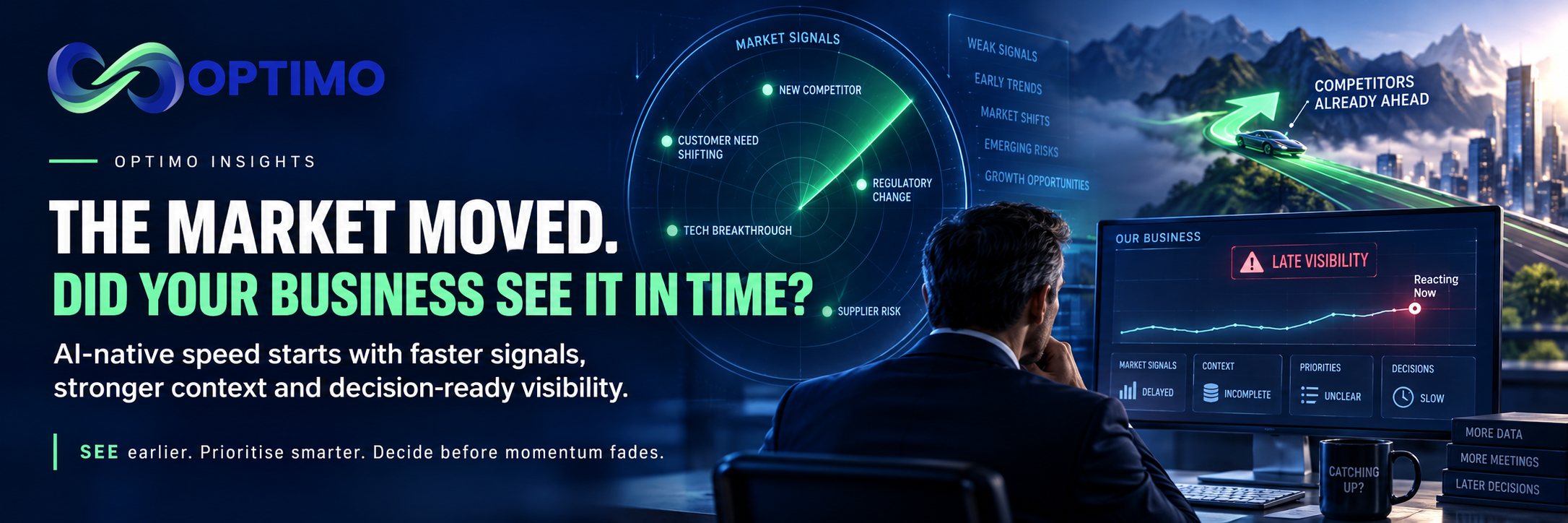
Why Quarterly Market Intelligence Is Already Too Late
Quarterly market reports are not inherently outdated or useless. They remain valuable for structured review, governance and longer term planning. The limitation appears when periodic reporting becomes the organisation’s main way of detecting changes that may require a faster response. Continuous market visibility reduces the time between a meaningful signal appearing and the organisation becoming decision ready. It does not mean sending executives more alerts. It means detecting the signal, validating it, adding context, prioritising it and routing it to the right decision owner with enough confidence to understand what it means.
The report may be accurate. The response may still be late.
A competitor changes its pricing on Tuesday morning. Customers begin reacting that afternoon, and by Wednesday the sales team is hearing a different set of objections. On Thursday, the competitor expands the message through a new campaign. Your organisation captures all of this, validates the information and prepares a thoughtful competitor report. Leadership receives it the following week.
Nothing is necessarily wrong with the report. It may be accurate, well researched and professionally presented. The problem is that part of the response window has already disappeared by the time the information reaches the people who can decide what to do.
That is the difference between having market information and having market visibility early enough to use it. The practical question is not simply how often a report is produced. It is how long it takes for a material market change to become a decision ready signal inside the organization.
Why market intelligence is moving toward an always on capability
Competitive and market intelligence platforms are increasingly being designed around that problem. Gartner’s 2026 research describes these platforms as systems that gather information from diverse internal and external sources, analyse it and activate insights across corporate strategy, product strategy, go to market and revenue decisions. Gartner also highlights data aggregation, source validation, AI powered analysis and actionable outputs as critical capabilities for high stakes decision making.
BCG makes a similar observation from the strategy function. Its 2026 research argues that AI can support always on strategy by reducing the time required to gather and process information. BCG notes that emerging competitive intelligence platforms can continuously scan very large numbers of sources and notify strategists when relevant announcements occur. It also reports that market intelligence and research are among the strategy activities where AI tools are already showing comparatively consistent positive impact.
McKinsey adds an important caution. AI can accelerate research, analysis and insight generation, but strategic advantage still depends on proprietary information, human interpretation and the ability to separate meaningful signals from noise. Faster information is useful only when the organisation can understand what matters and make a good decision from it.
This is why continuous market visibility should not be confused with real time everything. A dashboard can refresh every second and still create poor intelligence. An organisation can receive hundreds of alerts and become less informed because the important signal is buried inside noise.
The real delay sits between market change and decision readiness
The most useful way to examine market intelligence is to map the path between an external change and a leadership decision. A signal appears in the market. Someone detects it. The information is checked. Context is added. The right owner receives it. The organisation decides whether to ignore, monitor, investigate or act.
Every one of those steps can introduce delay. In some organisations, frontline employees recognise the change first but have no reliable path for escalating it. In others, the intelligence team produces excellent retrospective reports but spends too much time collecting and formatting information before leadership sees it. Some organisations detect signals quickly but treat every change as equally important, which creates an alerting problem rather than an intelligence capability.
A further problem appears when nobody clearly owns the next decision. Faster intelligence simply reaches another queue. The purpose of SEE is therefore not to maximise the number of signals. It is to reduce the distance between a meaningful market change and a decision ready understanding of what it means.
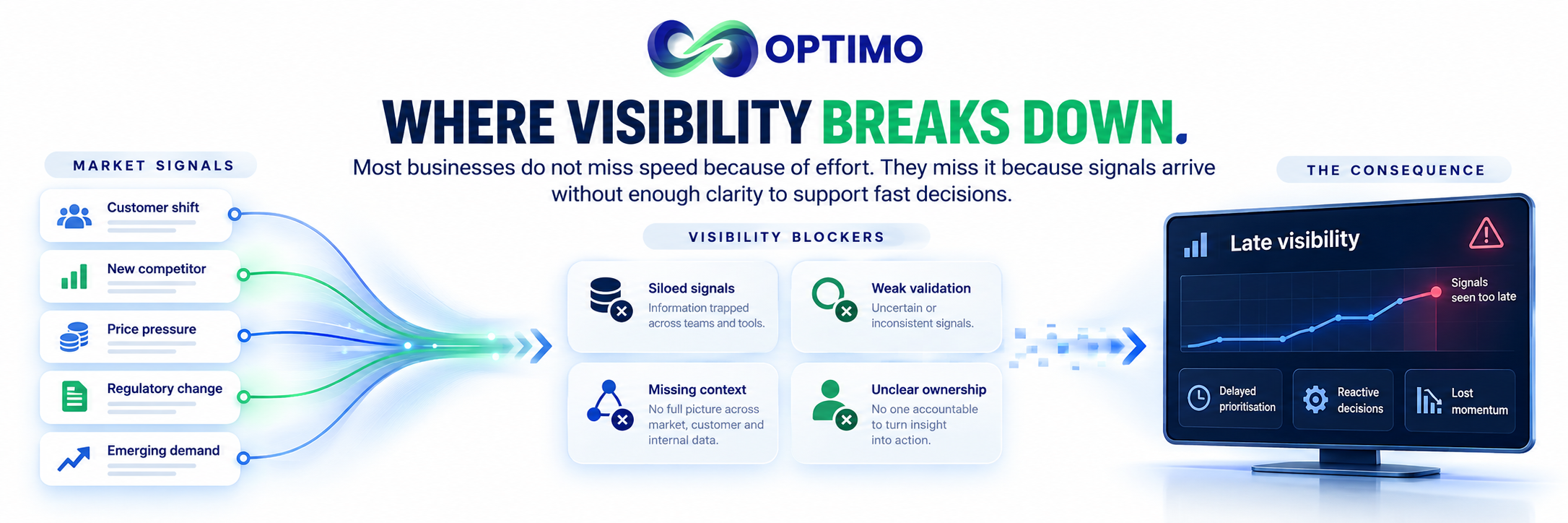
Six signs your organization has a market visibility problem
A practical SEE operating loop
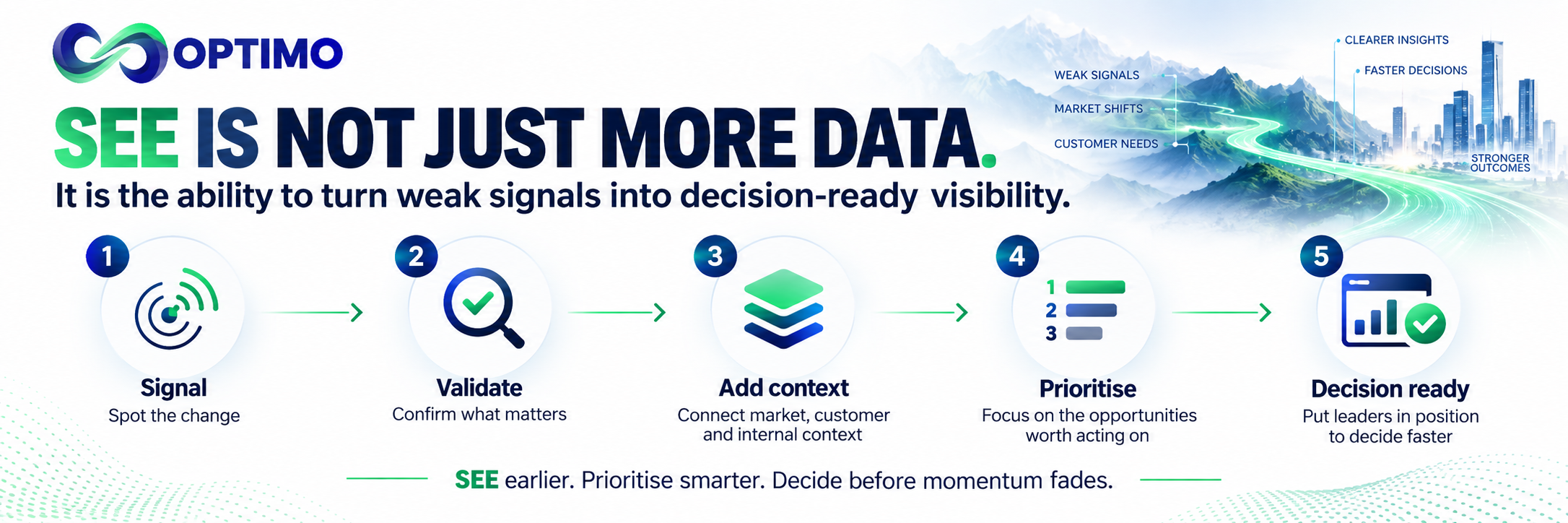
Continuous visibility works better when it is treated as an operating loop rather than a reporting schedule. A simple SEE version is: signal, validate, add context, become decision ready and learn. The technology can accelerate each stage, but the organization still needs clear rules about what matters, how confidence is established and who owns the interpretation. Once the organization is decision ready, ACT begins.
Signal: define what is worth watching
The first mistake is trying to monitor everything. Start with signals connected to real business questions. Depending on the organisation, those may include competitor pricing, new products, partnerships, market entry, regulation, customer sentiment, hiring activity, leadership changes, acquisition activity, positioning shifts or service gaps.
The key is the connection to a decision. A competitor pricing change matters because it may alter the economics of the market. A new product feature matters because it may reveal a customer expectation the business does not currently meet. A signal without a business question is simply information.
Validate: do not confuse speed with certainty
A fast signal can also be wrong. AI may identify a social media post, job advertisement, pricing page change or product update within minutes, but leadership should not act simply because something appeared. The organization needs to know whether the source is credible, whether the change is material, whether another source supports it and how confident the team is in the interpretation.
This is particularly important in regulated organizations. Continuous intelligence should reduce avoidable delay without removing appropriate judgement.
Decision ready: give the signal an owner
Once a signal is validated and contextualised, it needs a clear route to the person or team responsible for interpreting its business significance. The immediate outcome may be to ignore it, keep watching, investigate further or escalate it for a decision. The purpose of SEE is to make the signal decision ready, not to execute the response itself.
The important point is that intelligence should not disappear into another report. SEE should end with a trusted, contextualised signal in front of the right decision owner. That is the handoff point into ACT, which determines how the organisation executes once the decision is made.
Learn: improve what you monitor next
Fast market intelligence creates little value if it does not improve decision readiness. A better measure is whether the organisation surfaced a material signal with enough confidence and context while there was still time for leadership to assess it. That means looking beyond the number of sources monitored, alerts generated or reports produced.
The learning loop matters just as much. After a signal has been escalated or used in a decision, SEE should continue watching the market. Did the competitor change again? Did the signal strengthen or fade? Was the original source reliable? Were the thresholds too sensitive or not sensitive enough? Those observations should improve future source quality, confidence rules, thresholds and monitoring priorities.
Where AI helps and where it should stop
The volume of external information is already too large for teams to monitor manually across every relevant source. AI can reduce that burden through source monitoring, entity tracking, change detection, classification, summarisation, duplicate removal, signal clustering, competitive comparison, historical context and priority scoring.
The useful role is to reduce the time to understanding. It is not to remove the strategist. McKinsey argues that AI can make strategy work faster and more rigorous, but human judgement remains essential in complex strategic decisions. It also warns that the growing volume of data and generated insight makes signal separation and executive level synthesis more important, not less.
This distinction protects the organization from a common failure mode: replacing a slow quarterly report with a noisy real time feed. If alerts arrive faster but nobody knows which one’s matter, the organization has increased information velocity without improving market visibility.
A governed signal is more useful than another dashboard
A mature SEE capability gives important signals a definition, a trusted source or source set, a threshold, an owner and an escalation path. The organisation should also know what confidence is required before a signal moves to leadership and what kind of decision the signal is expected to inform.
This is especially relevant for banking, financial services and other regulated industries. Speed should not mean uncontrolled automated decisions. Source validation, data boundaries, access control, human review, named decision rights, escalation and auditability still matter. The goal is faster informed judgement.
A simple diagnostic: measure your visibility lag
Before buying another market intelligence platform, take one commercially important signal and map how it currently travels through the organisation. A competitor price change is a useful example.
Record when the market event actually occurred. Then record when your organisation first detected it, when someone added useful context, when the relevant decision maker received it and when the organisation was ready to decide. The gap between the market changing and the organisation becoming decision ready is the visibility lag.
That is often a more useful measure than the technical detection speed of an AI tool. A system can detect a page change in seconds, but if the organization needs several days to validate, contextualize and route it, the business still responds in days.
What leaders should ask for instead of another competitor report
The next time leadership asks for a market update, the more useful questions are: What changed since we last looked? Which changes are material? Which signals are strengthening? Which ones may be false positives? Which developments require a decision? Who owns that decision? What should we monitor next?
Those questions create intelligence. A report is only one possible delivery format.
What this means for established companies
Established organisations often already possess customer history, industry expertise, partner relationships, operating data, regulatory understanding, brand trust and institutional knowledge. The weakness is not always a lack of information. It is how slowly information becomes usable.
SEE is designed to make those existing advantages more responsive. It does not require replacing every research process or removing human judgement. It reduces the distance between the market changing and the organization understanding what deserves action.
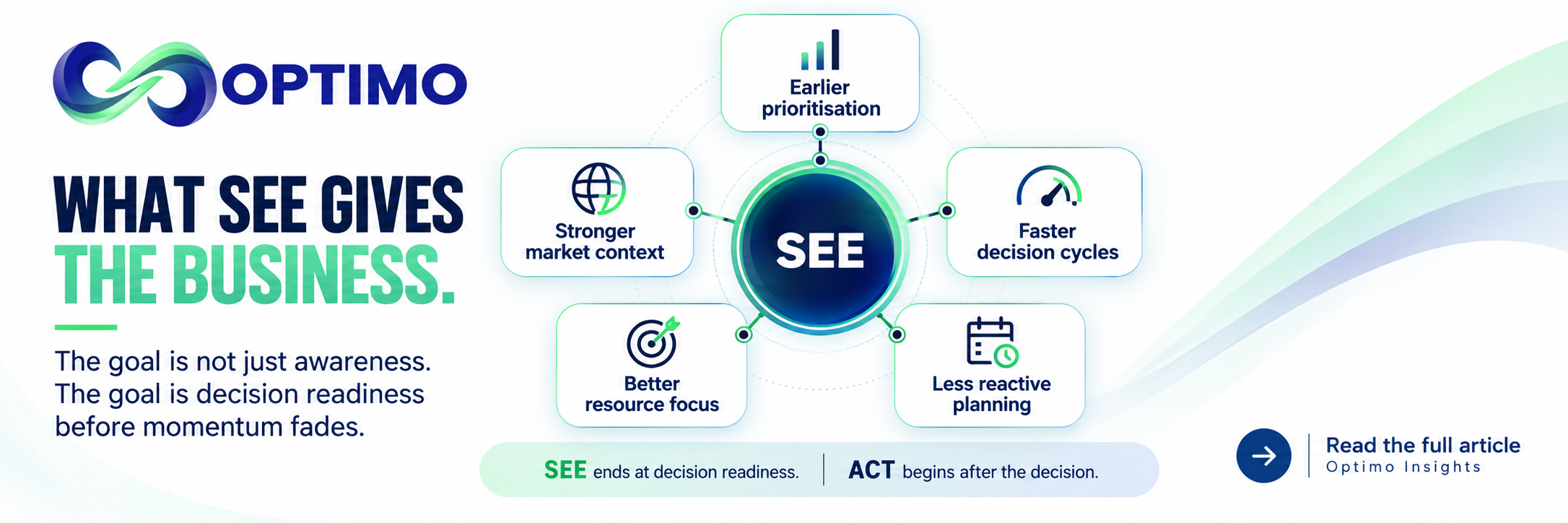
SEE is the first part of a larger execution loop
Market intelligence is valuable only when it connects to the rest of the organisation. SEE answers where the business may need to move. ACT turns the decision into governed execution. BUILD supports the response when technology or modernisation is required.
That is why the Optimo framework remains SEE. ACT. BUILD. The advantage is not any one pillar in isolation. It is the ability to move from signal to decision, from decision to execution and from execution to working technology before the market opportunity closes.
Identify the signals that matter
Your organization probably does not need to monitor everything. It needs to know which market signals could materially affect revenue, pricing, customers, products, technology, regulation or competitive position, and it needs a reliable way to move those signals from detection to decision.
Optimo’s Discovery Workshop can help map which signals matter, where they come from, how they are currently validated, who needs to see them, where decision latency occurs and which parts of the process can be supported by AI.
OPTIMO’s Discovery Workshop identifies one high value enterprise AI use case, maps its production readiness requirements and defines the practical path across ownership, workflow, data, integration, governance and delivery.
Sources and Publication Notes
1. Gartner, Magic Quadrant for Competitive and Market Intelligence Platforms, 21 April 2026. Supports the role of competitive and market intelligence platforms in activating insights from diverse internal and external data sources across strategy, product and go to market decisions.
2. Gartner, Critical Capabilities for Competitive and Market Intelligence Platforms, 22 April 2026. Supports the importance of data aggregation, source validation, AI powered analysis and actionable outputs for high-stakes decision making.
3. Boston Consulting Group, The Corporate Strategy Function in an AI First World, 12 March 2026. Supports continuously scanned competitive intelligence, always on strategy and the finding that market intelligence and research are among the strategy activities showing comparatively consistent positive AI impact.
4. McKinsey & Company, How AI Is Transforming Strategy Development, 5 February 2025. Supports AI as an accelerator of research and analysis while preserving the importance of proprietary insight, signal separation, executive synthesis and human judgement.