The Decision Was Made on Monday, Why Did the Work Start on Friday?
A business decision does not create value when it is approved. It creates value when the organisation can turn that decision into coordinated action. Many organisations have improved analytics, reporting and decision making but still lose time after the decision is made. Work waits for ownership, approvals, information, handoffs, system updates and follow ups. ACT is about reducing that gap. The goal is not to automate every task or remove human judgement. It is to design the operating flow so that once a decision is made, the right work moves to the right people and systems with clear ownership, appropriate controls and fewer avoidable delays.
The decision is finished. The waiting has just begun.
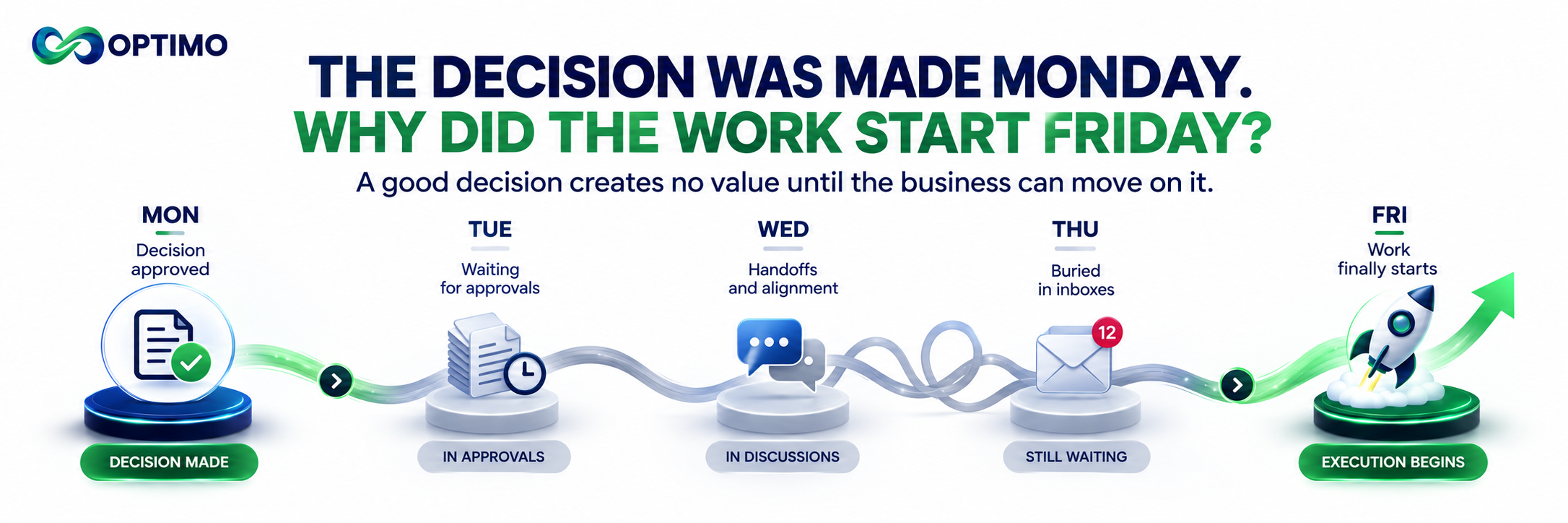
Imagine a leadership team meets on Monday morning. A customer issue is becoming commercially important. The data is clear. The decision is made. The company will change the approach. Everyone agrees.
Then the meeting ends. Operations needs instructions. Finance needs clarification. Legal needs to review one part. Technology needs requirements. A regional team needs to confirm ownership. Someone prepares a summary. Another person waits for the summary before opening a task. Two teams interpret the decision differently. By Wednesday, people are asking who owns what. By Friday, the first meaningful work begins.
The decision was not slow. The execution was. This is one of the most expensive forms of organisational delay because it is easy to miss. Leaders often measure how quickly a decision was reached but not how long the organisation took to mobilise after the decision.
A company can have faster analytics, better dashboards and more AI assisted decision support while still operating through workflows built around email, meetings, manual routing, status chasing and fragmented ownership. The intelligence improved. The operating flow did not.
The next AI advantage is better execution, not simply better answers.
The first phase of enterprise generative AI focused heavily on assistance: writing, summarising, researching and answering questions. The next phase is increasingly about what happens after the answer is known. Gartner has described a shift toward outcome focused workflows and has highlighted the decision execution gap: organisations may improve decision speed through AI and analytics but still struggle to translate those decisions into action.
That distinction matters. A recommendation is not an outcome. An approval is not an outcome. An AI generated insight is not an outcome. Even a correct decision is not yet an outcome. There is still work between the decision and the result. That is where ACT operates.
McKinsey and Deloitte make a similar point from the perspective of agentic AI. The emerging opportunity is not just a better assistant at an individual desk, but coordinated systems that can interpret requests, route work, trigger actions, handle defined exceptions and connect activity across functions while humans retain responsibility where judgement matters.
Why execution still slows down after everyone agrees
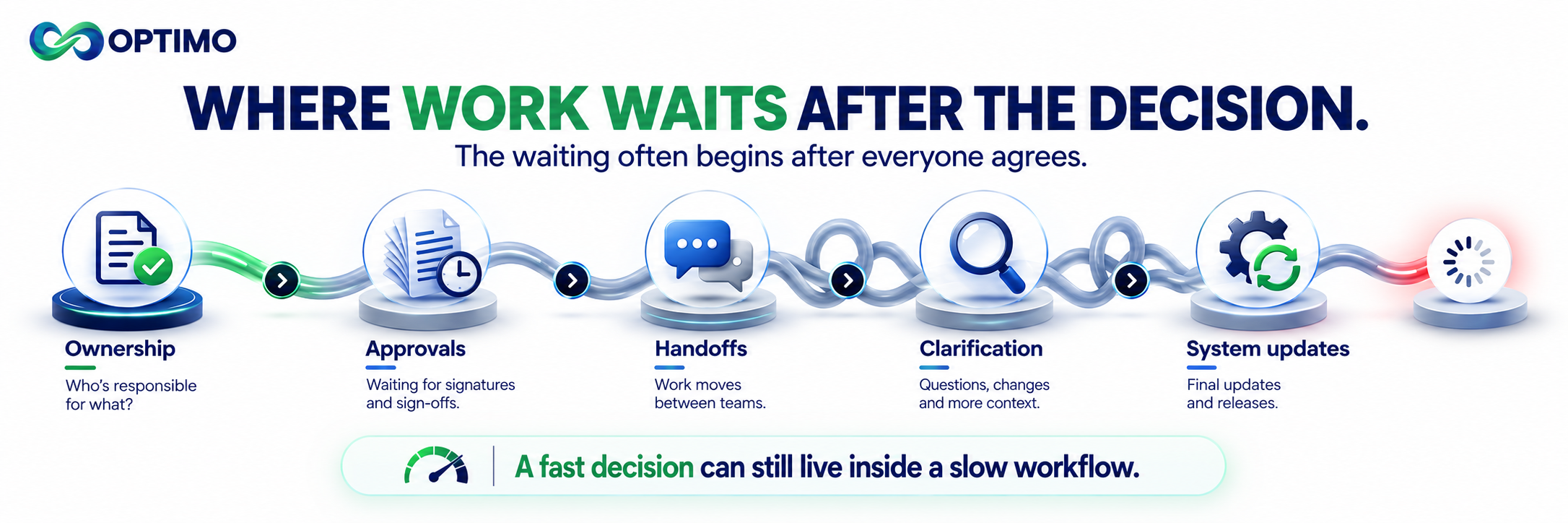
Execution delays are rarely caused by one dramatic failure. More often, they accumulate through small waits. A request sits in an inbox. An approval waits for a meeting. One team does not know another team has completed its part. Information is copied manually from one system into another. A task exists but has no clear owner. An exception cannot move because the workflow assumes every case is standard.
The individual delays may appear reasonable. Together, they create a slow organisation. This is why end to end process visibility matters. APQC emphasises the importance of mapping work across functional boundaries because handoffs are where local efficiency and overall business speed often diverge.
If one team reduces processing time from three hours to three minutes but the work still waits two days for the next handoff, the business barely feels the improvement. The process is only as fast as the flow around it.
Measure the waiting, not just the activity.
Most organisations measure activity: requests processed, approvals completed, cases closed, tasks handled. These measures are useful, but they can hide the real constraint. A better diagnostic starts with elapsed time. How much of the total cycle time was actual work, and how much was waiting?
Waiting for approval. Waiting for clarification. Waiting for ownership. Waiting for information. Waiting for another team. Waiting for a system update. Waiting for the next meeting.
Process mining and workflow analytics are increasingly used to reconstruct how work actually moves across enterprise systems. Their value is not simply technical visibility. They help reveal bottlenecks, rework, skipped controls and repeated manual steps that are otherwise normalized as part of everyday work.
Six signs you have an execution problem, not a strategy problem
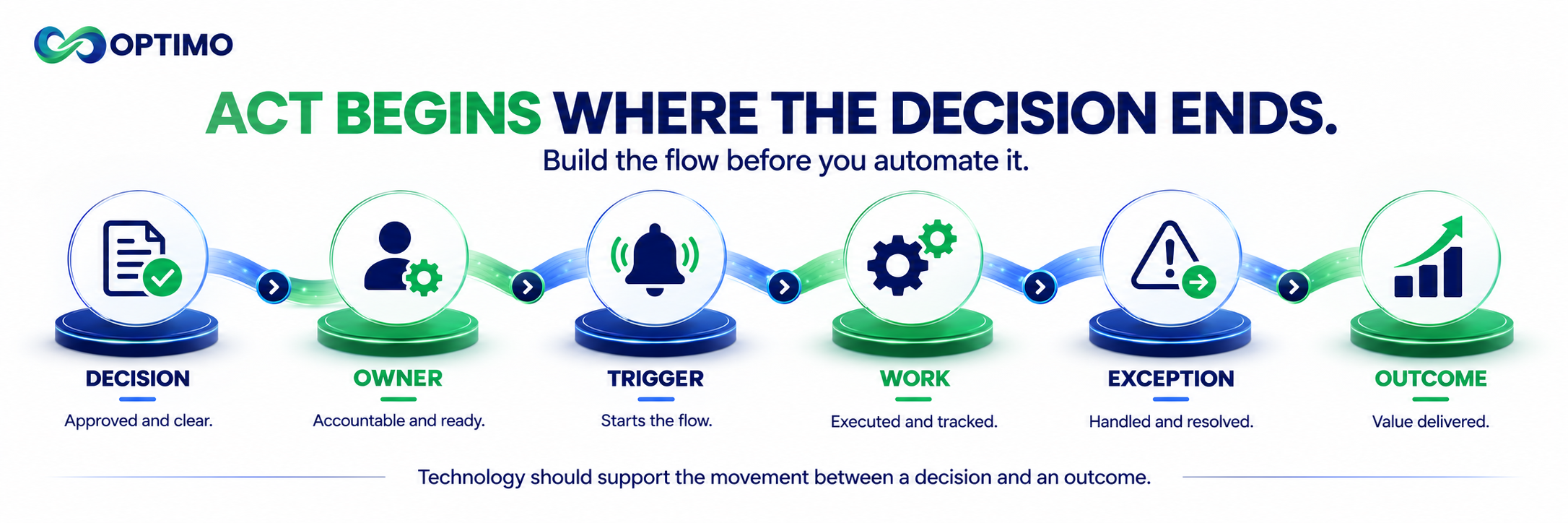
ACT begins where the decision ends.
ACT should not be understood as automating everything. It is better understood as designing the movement between a decision and an outcome.
A useful ACT flow is:
Decision → Owner → Trigger → Work → Exception → Outcome.
Decision defines what has been decided and under what authority. Owner makes accountability explicit. Trigger defines what should happen once the decision exists. Work separates human judgement from repetitive coordination. Exception defines the escalation path when the standard route does not apply. Outcome confirms whether the workflow produced the intended business result.
This is the operating logic that AI and automation should support. Technology should enter after the organisation understands how the work is supposed to move, not before.
Where AI agents change the execution model
Traditional automation is powerful when processes are predictable. If this happens, do that. Create the task. Send the notification. Update the record. But enterprise workflows often contain ambiguity. Inputs arrive in emails and documents. Priorities change. Exceptions require context from several systems. Routing may depend on risk, customer value or commercial urgency.
AI agents can expand the automation boundary because they can interpret less structured information and coordinate actions across systems. McKinsey describes the emerging agentic organisation as one built around redesigned workflows where agents coordinate work across domains while humans steer outcomes. Deloitte similarly emphasises orchestration: the ability for agents to interpret requests, delegate tasks, coordinate activity and validate outcomes across more complex workflows.
That opportunity also increases the importance of governance. The mature question is not simply whether AI can perform an action. It is under what conditions AI should perform that action, what it is allowed to access, which exceptions require a person and how the outcome is audited.
Do not automate a bad workflow.
If the process is unclear, automation does not create clarity. It can reproduce confusion faster. BCG’s work on operating models for the AI era makes a similar point: organisations need to make operating logic explicit so people and systems can understand how work should run.
Before applying AI or automation, map what starts the process, what information is required, who owns the outcome, where work waits, which steps add value, which controls manage genuine risk, where rework occurs, what exceptions are common and which actions can safely be automated. Technology comes after the operating logic.
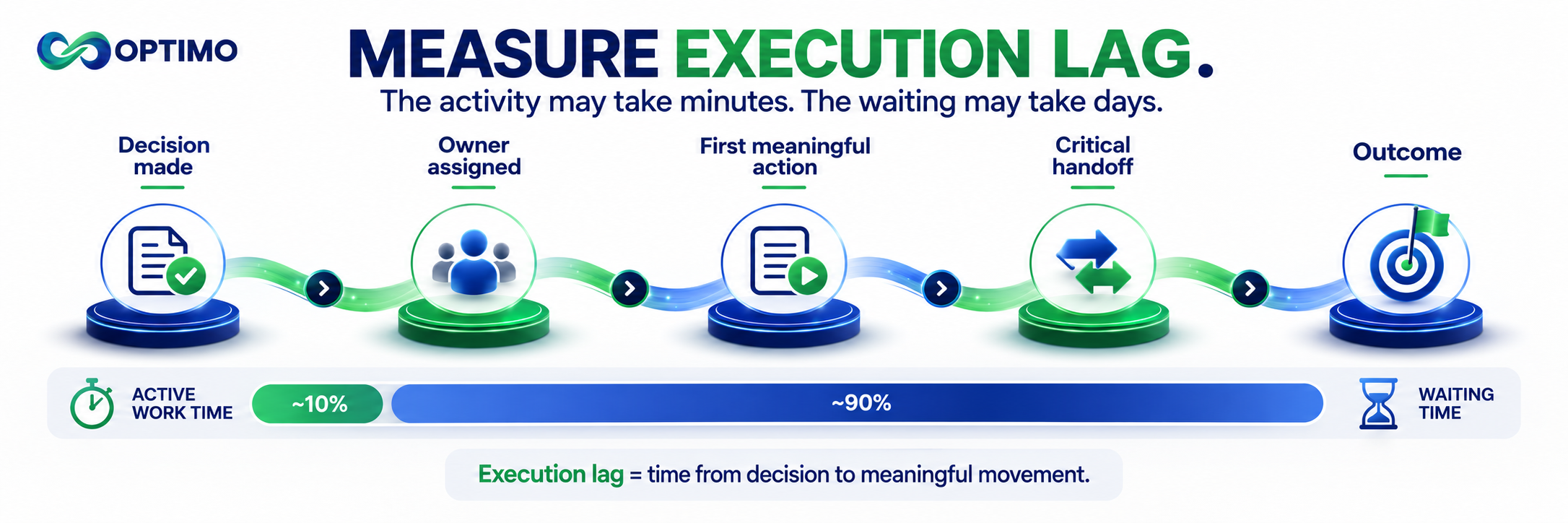
A practical ACT diagnostic: measure execution lag
Week 5 introduced visibility lag: the time between the market changing and leadership becoming decision ready. Week 6 introduces the next measure: execution lag.
Execution lag is the time between a decision being made and meaningful work beginning. Choose one important recurring decision and record five moments: when the decision became final, when an owner became clearly accountable, when the first meaningful action began, when the critical handoff was completed and when the intended outcome was achieved.
Then examine the gaps. The activity may take minutes. The waiting may take days. That is the execution opportunity.
What should be automated first?
Do not begin with the workflow that looks most impressive in a demonstration. Begin with the workflow where delay is expensive. The strongest candidates are frequent, measurable, reasonably well understood, cross functional and connected to a business outcome that materially improves when execution becomes faster.
Speed matters when it changes revenue, customer experience, risk, cost, working capital, service quality or competitive responsiveness. If faster execution does not improve a meaningful outcome, the workflow may not deserve priority.
Human judgement should become more deliberate, not disappear.
The objective of ACT is not human removal. It is better placement of human judgement. Routine routing, standard updates, copying information between systems and checking predefined conditions may not require a person. Exceptions, high consequence decisions, customer relationships, ethical judgement and risk interpretation often still do.
OECD research on algorithmic management highlights both the potential of automated decision support and the need for accountability, explainability, transparency and human oversight. Those principles become even more important when AI moves from recommending to acting.
ACT in regulated organisations requires speed with control.
Banking, financial services, insurance, healthcare, government and other regulated environments do not need to choose between speed and governance. A governed ACT model can define who may trigger actions, what data an agent can access, which actions require human approval, what confidence threshold applies, how exceptions are escalated, what is logged and how outcomes are audited.
The future of workflow automation is not uncontrolled autonomy. It is governed autonomy.
Why this matters now for Malaysia
Microsoft’s recent Malaysia work trend research points to a growing gap between individual AI adoption and organisational redesign. Employees are adopting AI quickly, while leadership alignment, incentives and operating structures can still reinforce older ways of working. That creates a transformation paradox: people become faster while the organisation around them remains slow.
This is why the opportunity is bigger than giving employees another AI tool. The larger opportunity is redesigning how work moves around them.
What leaders should ask before buying another automation platform
Do not begin with which AI agent platform to buy. Begin with which decisions are taking too long to become action. Then ask where work waits after the decision, which handoffs repeatedly slow it down, which approvals genuinely control risk, which approvals exist from habit, where employees manually coordinate work that systems should coordinate and what business outcome would improve if the execution lag disappeared.
Those questions create an automation strategy. A list of tools does not.
From SEE to ACT to BUILD
The Optimo model is designed as a connected system. SEE determines what deserves attention and gets leadership decision ready. ACT turns that decision into coordinated, governed execution. BUILD changes or creates the technology required when existing systems cannot support the desired operating model.
The sequence matters. Automating before understanding the problem can accelerate the wrong process. Building technology before designing the operating flow can digitise unnecessary complexity. The stronger approach is simple: SEE clearly. ACT deliberately. BUILD what the business actually needs.
Find where your decisions are waiting
Most organisations already know more than they are able to execute. The next opportunity may therefore not be another dashboard, another AI assistant or another strategy exercise. It may be the invisible time between ‘We have decided’ and ‘The business is moving.’
Take one important workflow. Start at the moment the decision is made. Follow it until the outcome is achieved. Measure every handoff, queue, approval and exception. Then ask one question: Which delay would matter most if it disappeared?
That is where ACT should begin.
OPTIMO’s Discovery Workshop identifies one high value enterprise AI use case, maps its production readiness requirements and defines the practical path across ownership, workflow, data, integration, governance and delivery.
Sources and Publication Notes
1. Gartner: Research on the decision execution gap and the shift toward outcome focused workflows.
2. McKinsey & Company: Research on agentic organisations and redesigned AI enabled workflows.
3. Boston Consulting Group: Research on explicit operating logic and operating models for the AI era.
4. Microsoft Work Lab: Research on fragmented work, AI enabled work and Malaysian workforce transformation.
5. APQC: Guidance on end-to-end process design and cross functional process visibility.
6. Deloitte: Research on AI agent orchestration and coordinated execution.
7. OECD: Research on algorithmic management, accountability, explainability and human oversight.