
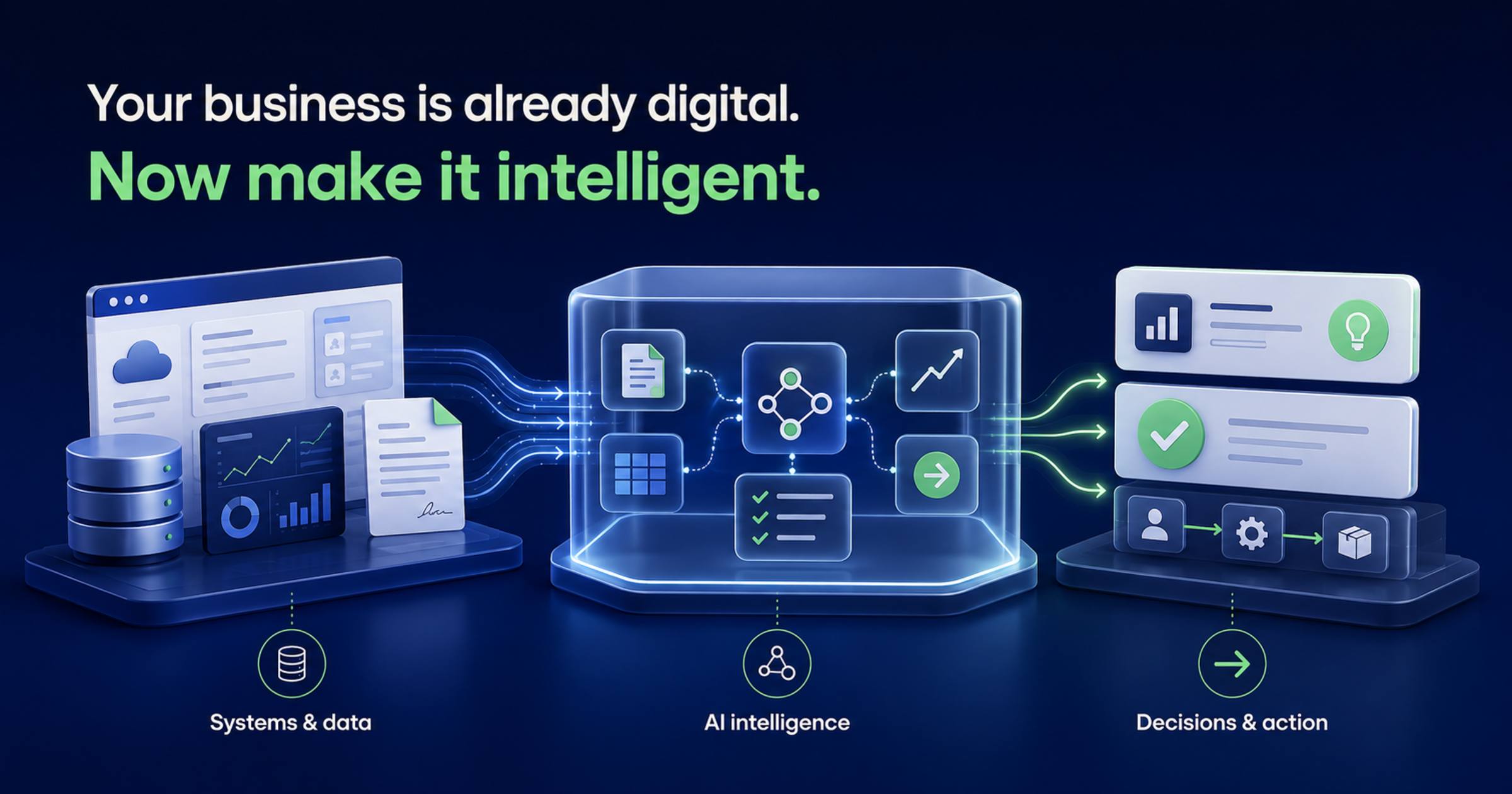
Digital did not automatically make the organisation intelligent
The conversation around digital transformation Malaysia is entering a new phase. Organisations have invested in cloud platforms, portals and digital processes; the next question is whether those systems can help the business interpret, decide and execute faster.
Most organisations have already completed some form of digital transformation. They have cloud applications, dashboards, portals, mobile experiences and digitised records. Yet many leadership teams still wait for reports, employees still chase approvals through email, and technology changes still take months.
That is the gap between being digital and being AI-enabled.
Digital transformation improved access to information and moved work into systems. AI enablement changes what those systems can do with the information. It introduces interpretation, recommendation, automation and continuous learning into the operating model.
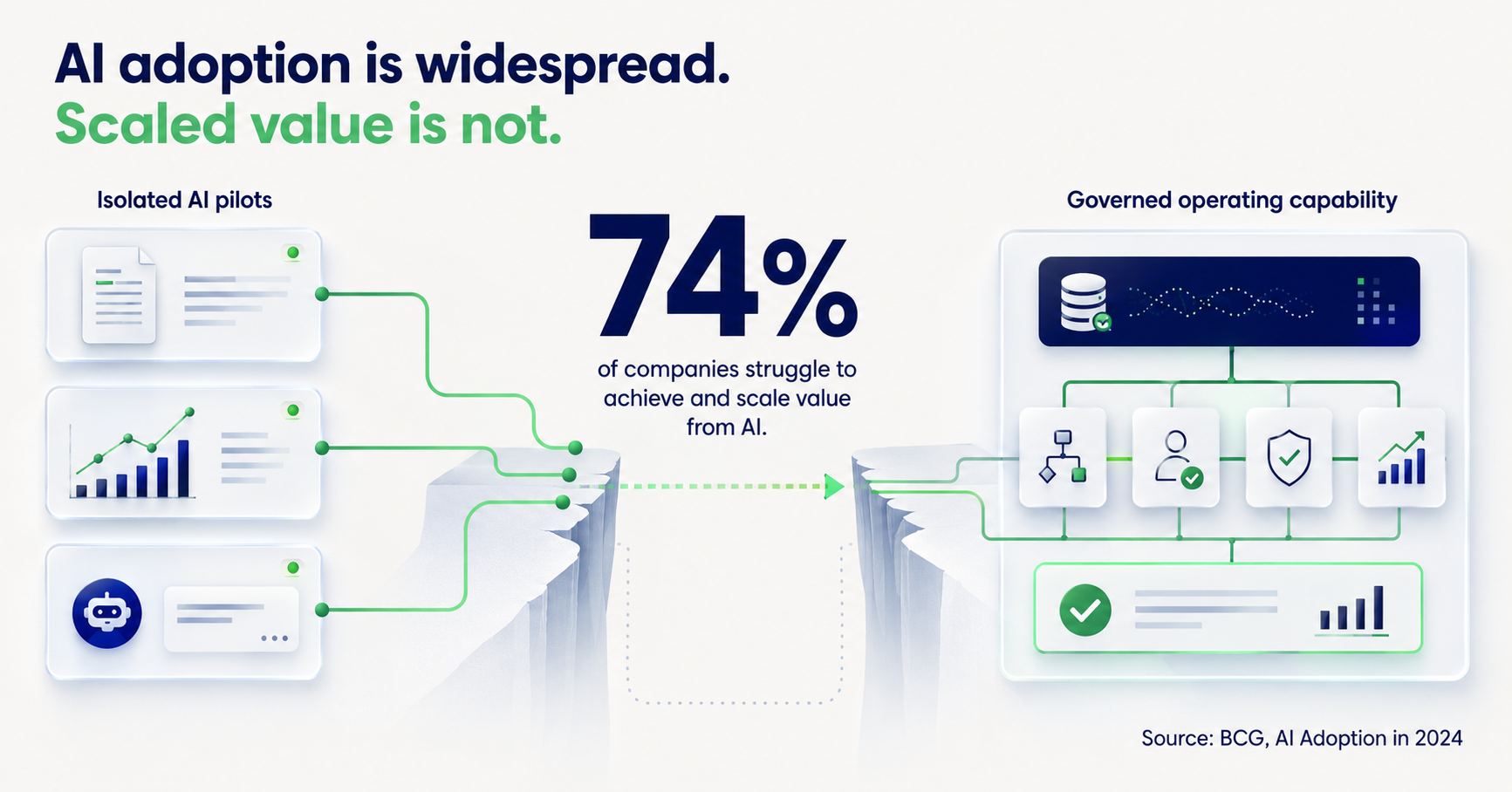
McKinsey’s 2025 global survey reported that AI use had become widespread, while most organisations remained in the early stages of scaling it and capturing enterprise-level value. BCG’s 2024 research similarly found that most companies were struggling to achieve and scale value from AI, while a smaller group of leaders was pulling ahead. [1][2]
This is the purpose of AI business transformation: not replacing every digital investment, but connecting intelligence and execution to the operating model.
What digital transformation achieved and where it now plateaus
Digital transformation was necessary. It gave organisations cleaner data, online channels, integrated applications and a base for modern operations. The mistake is assuming that the presence of digital systems automatically creates faster decisions or more intelligent work.
A dashboard can show yesterday’s performance without explaining why it changed. A workflow can move a request from one inbox to another without understanding the document attached. A cloud application can still depend on manual reconciliation. A modern customer portal can still be supported by slow legacy processes behind the scenes.
The next operating shift is not simply more digitisation. It is the ability to connect information, judgement and execution.
Six signs the business is digital but not yet AI-enabled
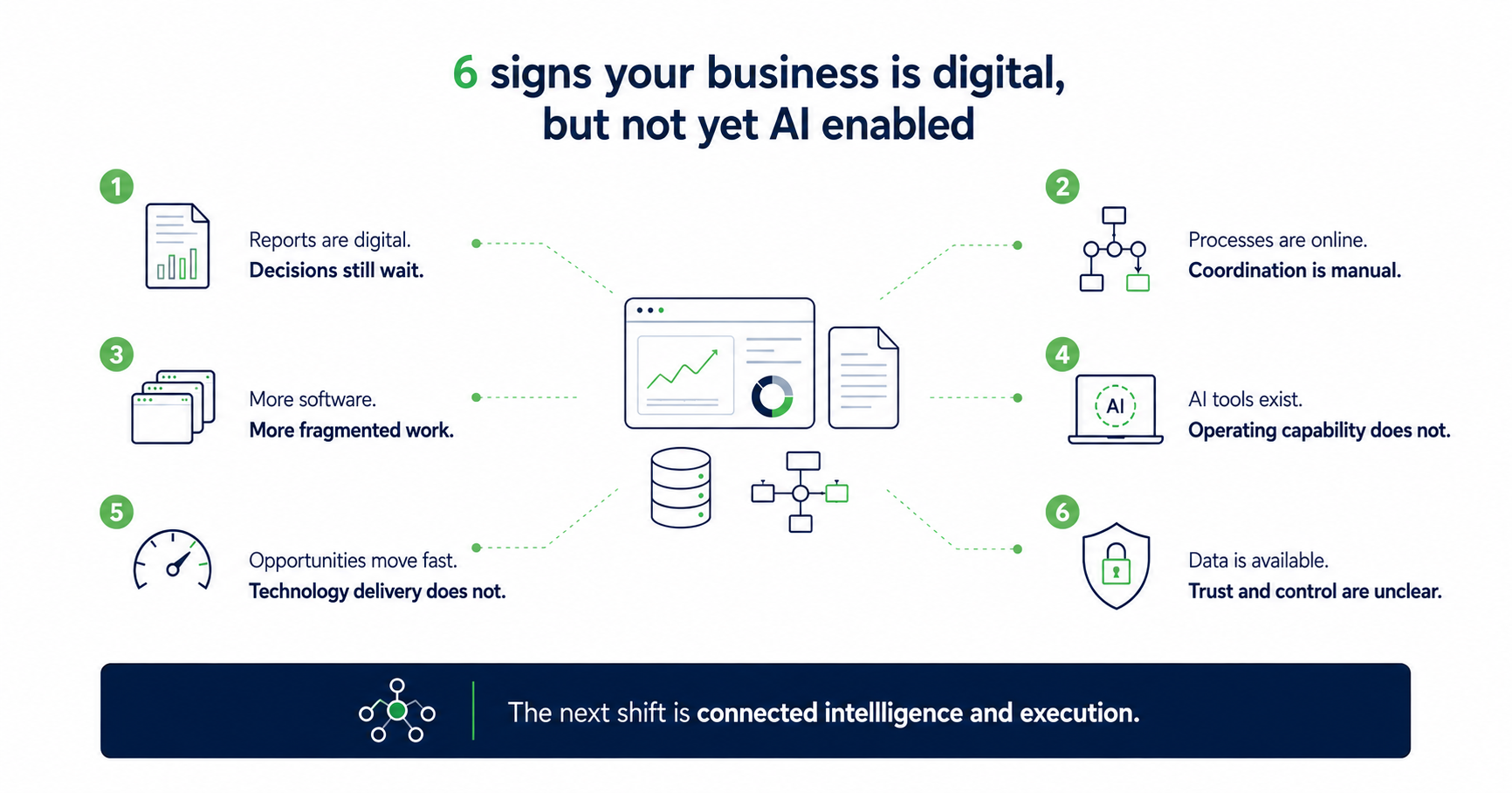
- Reports are digital, but decisions are still delayed. Leadership receives information faster than before, but the organisation still depends on periodic reporting rather than continuous market and operational signals.
- Processes are online, but people still coordinate them manually. Forms may be digital while approvals, reminders, exception handling and follow-ups remain dependent on employees.
- The organisation owns more software, but work is more fragmented. Each department has its own tools, yet the complete process crosses multiple systems and loses visibility between them.
- AI exists as isolated tools, not an operating capability. Employees may use assistants and copilots, but the organisation has not connected AI to governed workflows, approved data or measurable outcomes.
- Technology delivery remains a bottleneck. The business can identify an opportunity quickly, but requirements, development, testing and release processes prevent a fast response.
- Data is available, but trust and control are unclear. Teams want to use AI, while security, legal and risk stakeholders cannot see where data goes, which models are used or who approves sensitive actions.
The shift from digital systems to AI execution
The value of AI does not come from adding a chatbot to every application. It comes from changing how the organisation sees, acts and builds.
Optimo uses three connected pillars:
- SEE: AI Market Intelligence. Continuously organise competitor, product and market signals so leadership can identify gaps and opportunities earlier.
- ACT: AI Workflow Automation. Coordinate approvals, reporting, documents, follow-ups and knowledge work through governed workflows and AI agents.
- BUILD: AI-Assisted Software Delivery. Use AI across requirements, system knowledge, development, testing, documentation and release preparation.
Beneath all three pillars is a control layer: data boundaries, approved models, access permissions, human oversight, deployment choices and auditability.
A practical AI adoption strategy and AI implementation roadmap
- Start with business pressure, not technology. Identify the decision delay, manual process, market blind spot or delivery bottleneck that matters commercially.
- Establish the baseline. Measure cycle time, manual effort, error rate, opportunity delay, backlog or another relevant indicator before introducing AI.
- Map data, systems and ownership. Clarify what information is required, where it sits, who owns the process and which controls apply.
- Choose one focused use case. Select a problem with a clear owner, reachable data and a measurable result. Avoid beginning with a broad promise to transform the entire organisation.
- Design the production path before the demonstration. Define integration, identity, model access, approval points, monitoring, support and operating responsibility from the beginning.
- Prove value and scale deliberately. Expand only after the use case has demonstrated business value, operational adoption and acceptable risk.
- Confirm readiness before scaling. Use an AI readiness assessment to verify business ownership, data, systems, governance and delivery capability before expanding the programme.
What leaders should do next
The first leadership question should not be, “Which AI platform should we buy?” It should be, “Where is the organisation losing speed, capacity or visibility: and what would change if that constraint were removed?”
A useful first session should produce three outputs: one market visibility gap, one workflow ready for automation and one technology bottleneck slowing delivery. From there, the organisation can select a practical first move rather than creating another technology programme without a clear outcome.
Build your AI transformation roadmap
Optimo’s Discovery Workshop identifies the most valuable starting point across market intelligence, workflow automation, sovereign AI and software delivery.
Frequently asked questions
Sources and publication notes
- McKinsey: The State of AI: Global Survey 2025: AI adoption was widespread, while most organisations remained early in scaling and enterprise value creation.
- BCG: AI Adoption in 2024: 74% of Companies Struggle to Achieve and Scale Value: BCG reported a significant value gap between AI leaders and the rest.
- OECD: Digital Transformation: Defines digital transformation as the impact and use of digital technologies and data across existing and new activities.