
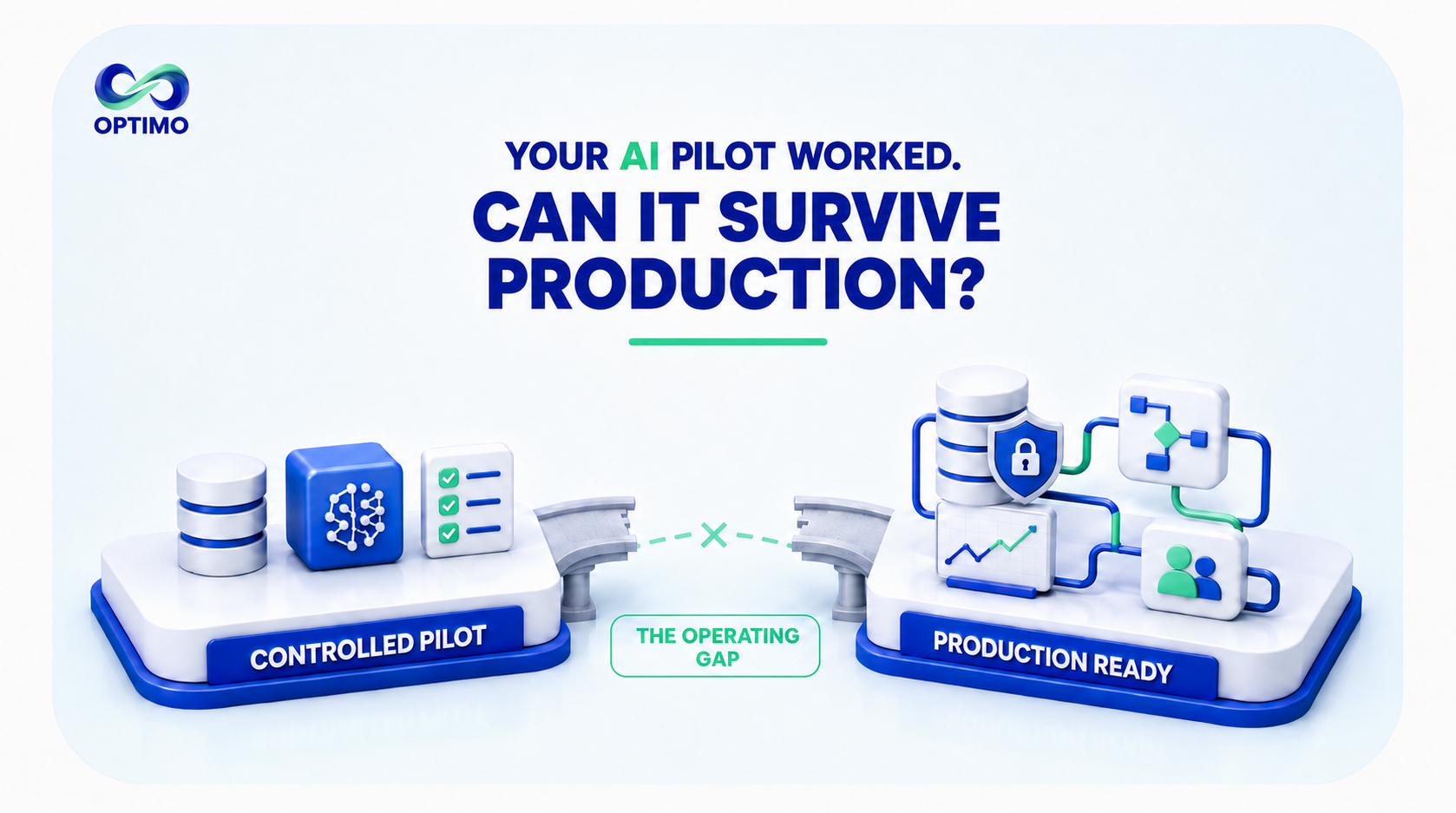
The pilot worked, but the organisation did not change.
An AI pilot can deliver an impressive demonstration in weeks. It can classify documents, answer questions from internal knowledge, identify patterns in operational data or recommend the next action. The model performs. Stakeholders are interested. The presentation ends with a request to scale.
Then progress slows.
Security asks where the data will move. Technology teams ask how the solution will connect to identity, applications and monitoring. Risk teams ask who approves sensitive outputs. Operations asks who will support the capability when it fails. Business leaders ask when the value will appear.
None of these questions means that the pilot failed. They reveal that the pilot answered only one question: can the capability work?
Production asks a larger set of questions. Can it work with real users, real permissions, live data, business exceptions, regulatory requirements, service expectations and clear accountability?
This is the central challenge for enterprise AI Malaysia. The barrier is often not the absence of ideas or tools. It is the absence of a designed path from demonstration to an operating capability.
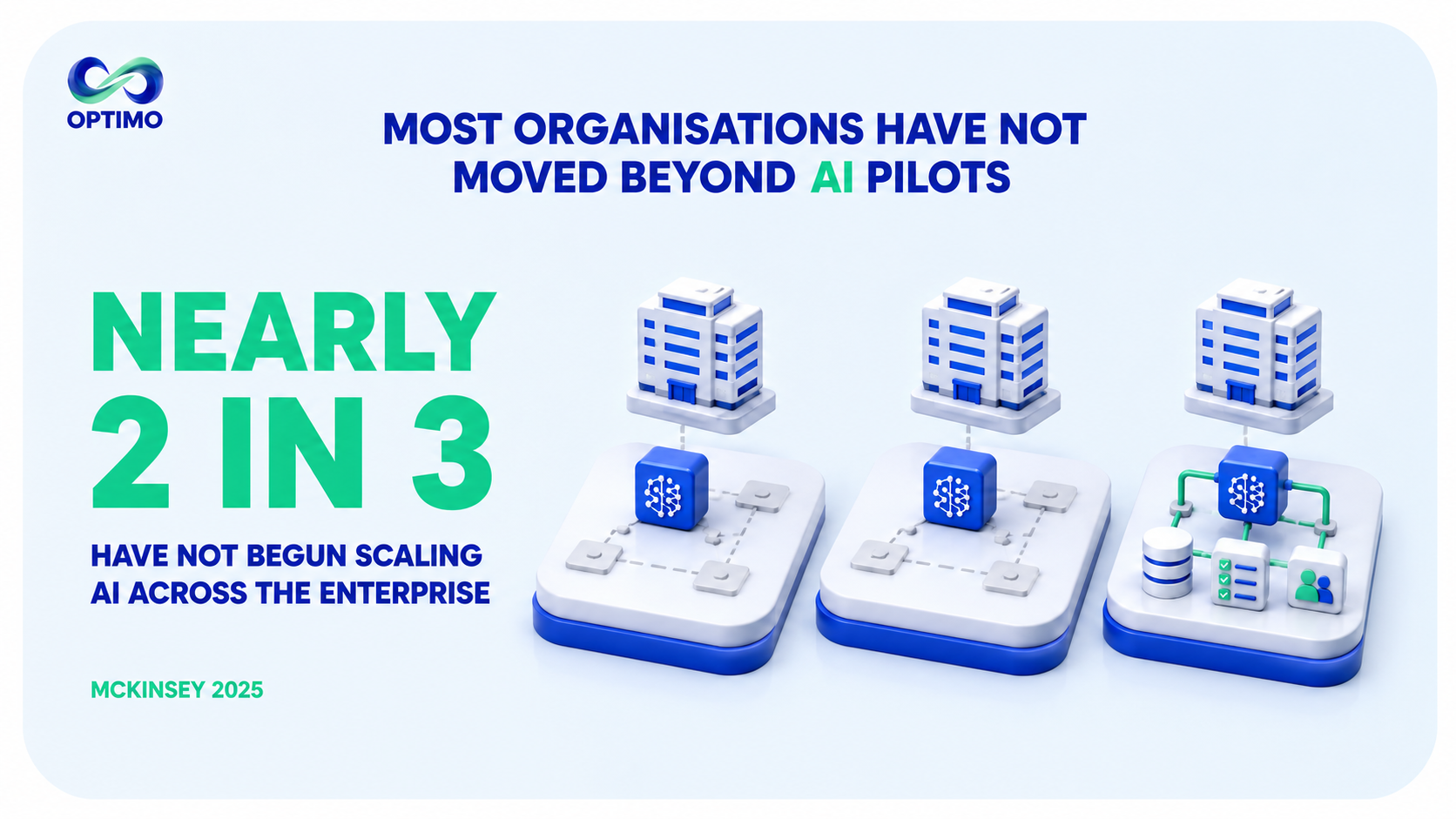
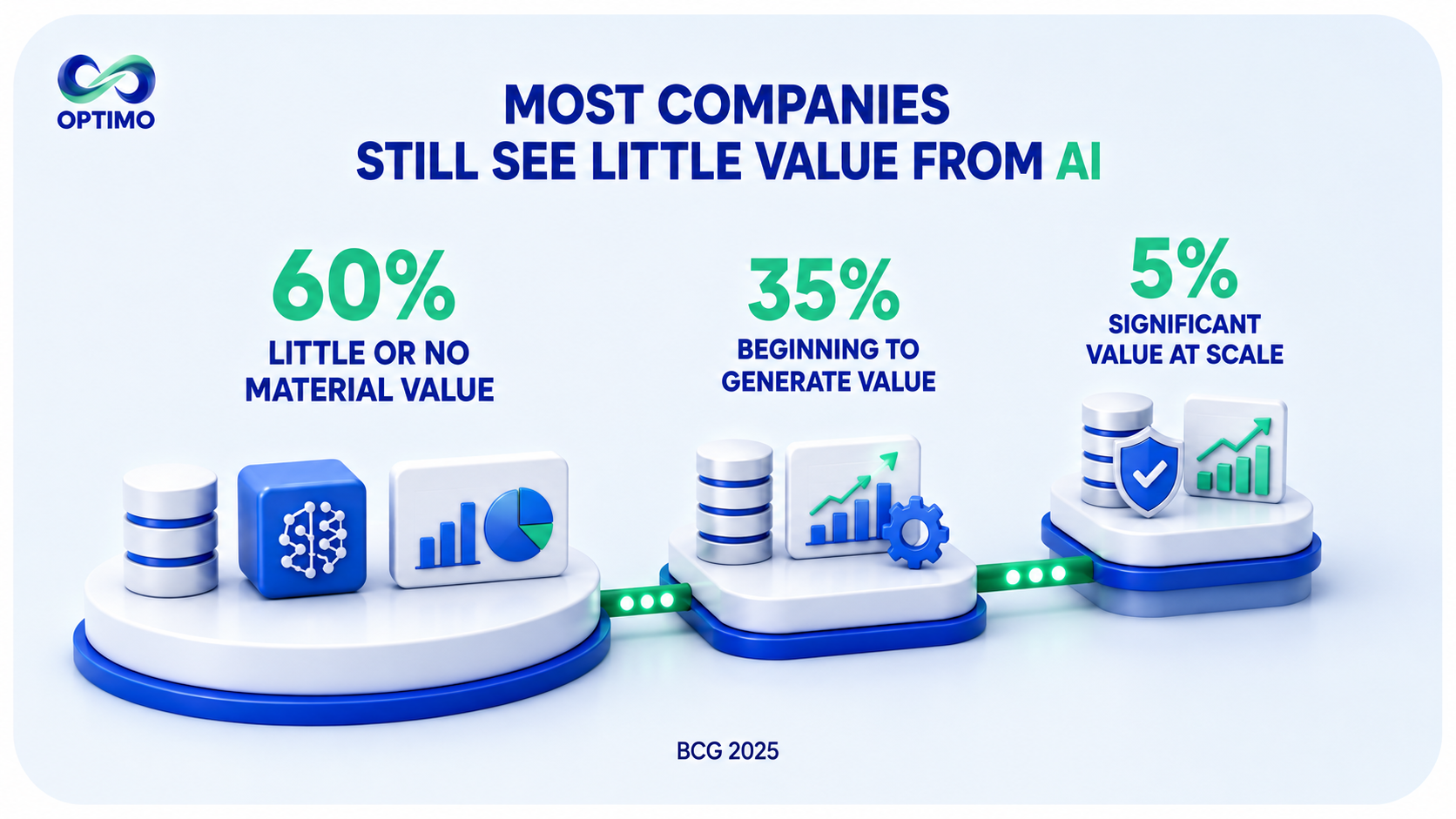
McKinsey’s 2025 global survey found that nearly two thirds of respondents said their organisations had not yet begun scaling AI across the enterprise, even though AI use had become widespread. BCG’s 2025 research similarly separated a small group of companies generating material value from a much larger group seeing limited returns. The distance between adoption and value is increasingly the distance between running tools and changing how the organisation operates.
An AI pilot proves that a use case can work under controlled conditions. Enterprise scale requires the same capability to work repeatedly with live data, secure access, integrated workflows, accountable owners, measurable outcomes, monitoring and operational support. Most pilots stall because the organisation validates the technology before designing the production environment around it.
What an AI pilot proves and what it does not
A useful pilot should prove a narrow hypothesis. It may show that a model can extract information accurately enough, retrieve relevant knowledge, assist a decision, reduce manual review or automate selected steps.
That evidence matters. But it does not automatically prove production readiness.
A pilot usually operates with temporary advantages. The team may use a prepared dataset, a small user group, manual checking, broad test permissions and direct support from the people who built it. Exceptions can be handled informally. Costs may not reflect continuous usage. Monitoring may consist of someone watching the demonstration.
Production removes those advantages.
The capability must operate when data quality varies, permissions differ, users behave unpredictably, volumes rise and the original project team is no longer standing beside it. It must fit the organisation’s workflow, control environment and service model.
The correct conclusion after a successful pilot is therefore not, “The solution is ready to scale.”
It is, “The use case has earned a production readiness decision.”
Seven reasons successful AI pilots remain isolated
1. The business problem becomes less precise as the project expands
Pilots often begin with a clear task but scale discussions quickly become broad. A document review assistant turns into a plan to transform the complete function. A knowledge search use case becomes an enterprise assistant for everyone.
The wider promise weakens ownership and measurement. RAND’s research on AI project failure found that misunderstanding the problem, optimising the wrong metric and failing to fit the real workflow were leading causes of failure. [3]
Scale should deepen the proven business outcome before it broadens the ambition.
2. The pilot has a sponsor, but production has no operating owner
An executive sponsor can authorise a pilot. Production requires someone to own the outcome after launch.
That owner must decide which users are included, what service level is acceptable, how exceptions are handled, when human approval is required, which performance indicators matter and who funds continuous improvement.
If ownership ends when the pilot presentation ends, the capability remains a project rather than becoming part of the operating model.
3. Temporary data access is mistaken for a production data design
A pilot may receive a static export or specially prepared dataset. Production needs repeatable access to live information with defined quality, lineage, permissions, retention and usage boundaries.
The question is not only whether data exists. It is whether the organisation can approve and sustain the way the AI capability accesses it.
Without that design, teams either stop at governance review or build fragile manual processes to keep the solution running.
4. Integration is postponed until after the demonstration
An isolated interface can prove model capability. It cannot prove operating value if employees must leave their existing work, copy information between systems or create another queue to use it.
Production value normally appears when AI is connected to the point of work: a case, approval, document, customer interaction, knowledge task or delivery workflow.
Identity, application interfaces, event triggers, audit logs and exception routes should be considered before the pilot architecture becomes difficult to change.
5. Governance arrives as a final approval gate
When risk, security, privacy and legal teams first see the use case at the end, they are forced to evaluate an already designed solution. Their safest response may be to delay it.
Governance works better when it shapes the path from the beginning. Data boundaries, approved models, human oversight, testing, explainability, logging and escalation should be part of the production design.
NIST’s AI Risk Management Framework organises this work through four connected functions: Govern, Map, Measure and Manage. Malaysia’s National AI Office also positions responsible AI around the design, development and deployment lifecycle through the National Guidelines on AI Governance and Ethics and the voluntary AI Code of Ethics. [4][5]
Governance should enable a controlled path to production, not appear only as a reason to stop.
6. The pilot measures model performance instead of business performance
Accuracy, response quality and technical latency matter. They do not prove that the organisation is receiving value.
A production case should also measure cycle time, manual effort, error reduction, backlog, adoption, customer impact, risk exposure or another commercial and operational result.
If the business cannot see the baseline and the expected change, it cannot decide whether scale is justified.
7. No one designs the operating life after launch
AI behaviour can change as data, users, prompts, models and business conditions change. Production therefore needs monitoring, incident handling, access review, cost visibility, model evaluation, user support and an accountable change process.
The organisation should know who can pause the system, who investigates a poor output, who approves an update and how performance is reported.
Without an operating model, the pilot may be technically deployable but organisationally unsupported.
The production readiness stack
Moving from AI pilot to production requires six connected layers.
- Business ownership: A named owner is accountable for the outcome, adoption, funding and operating decisions.
- Workflow design: The capability is placed inside a defined process with clear inputs, outputs, exceptions and human decisions.
- Data and integration: Live data access, identity, application interfaces, permissions and system boundaries are designed for repeatable operation.
- Governance and control: Risk classification, approved models, testing, human oversight, logging and escalation are established before launch.
- Measurement: Technical performance and business results are measured against an agreed baseline.
- Operations: Monitoring, support, incident response, cost management and continuous improvement have clear owners.
Weakness in any layer can keep a successful pilot from becoming a reliable enterprise capability.
A practical roadmap from pilot to production
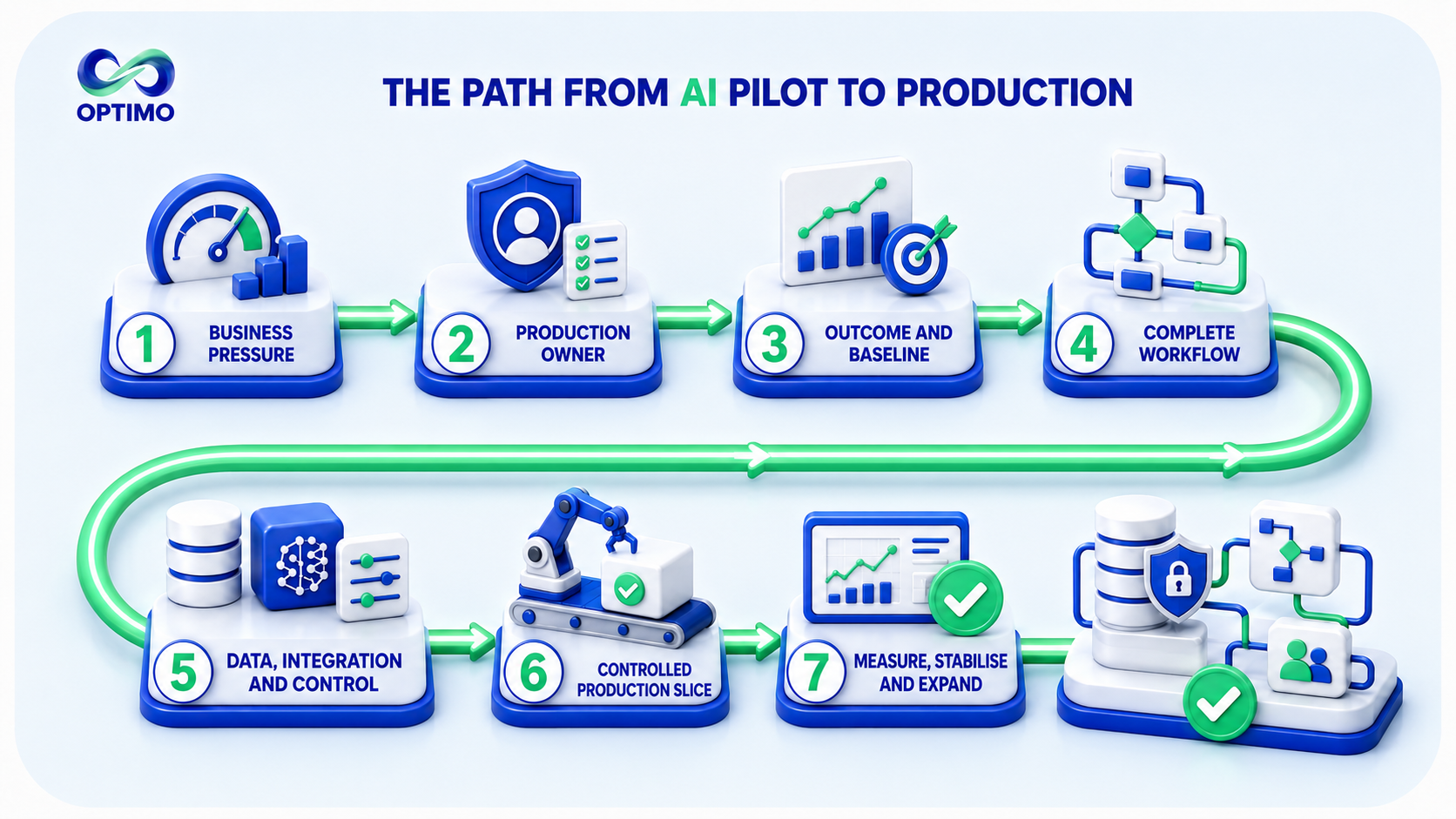
Step 1: Restate the business pressure
Define the operational problem in measurable terms. Identify where the organisation loses time, capacity, quality, visibility or revenue. Confirm that the use case remains important enough to operate, not only demonstrate.
Step 2: Name the production owner
Assign one accountable business owner and one accountable technology owner. Clarify who owns the outcome, the service, the risk decision and the improvement backlog.
Step 3: Define the production outcome and baseline
Agree on the indicators that will justify deployment. Measure the current process before AI is introduced so the organisation can demonstrate change rather than activity.
Step 4: Map the complete workflow
Document how information enters, where decisions occur, which systems are involved, what exceptions exist and where human judgement remains necessary. The AI capability should improve this workflow instead of becoming another disconnected tool.
Step 5: Design data, integration and control together
Specify data sources, permissions, identity, model access, system interfaces, retention, logging, approval points and deployment boundaries as one production design.
Step 6: Run a controlled production slice
Deploy to a limited but real operating group with live controls, monitoring and support. A production slice is different from another pilot because it tests the complete operating path, not only the model.
Step 7: Measure, stabilise and expand deliberately
Compare results with the baseline. Resolve adoption, quality, risk and support issues before expanding. Scale the operating capability only after it has demonstrated value and control in real conditions.
Five questions leaders should ask before approving scale
- Who owns the business outcome after the project team leaves?
- What live data and system access are required, and can they be governed continuously?
- Where does the capability sit in the real workflow, including exceptions and human approval?
- How will the organisation measure both business value and AI performance?
- Who monitors, supports, changes and, when necessary, stops the capability?
If these questions do not have clear answers, the organisation does not yet have a scaling plan. It has an intention to deploy.
What Malaysian organisations should do next
The next enterprise AI decision should not be how many pilots to launch. It should be which use case has the strongest combination of business pressure, accountable ownership, reachable data, feasible integration, measurable value and acceptable risk.
Start with one use case that matters. Design its production path before expanding its promise. Bring business, technology, data, risk, security and operations into the same decision early.
This approach is slower than announcing many pilots. It is faster than allowing successful demonstrations to remain permanently disconnected from the business.
Move one AI use case from proof to production
OPTIMO’s Discovery Workshop identifies one high value enterprise AI use case, maps its production readiness requirements and defines the practical path across ownership, workflow, data, integration, governance and delivery.
Frequently asked questions
Sources and publication notes
- McKinsey: The state of AI in 2025. Nearly two thirds of respondents said their organisations had not yet begun scaling AI across the enterprise.
- BCG: Are You Generating Value from AI? The Widening Gap. BCG reported that 5 percent of firms were future built, 35 percent were scaling and 60 percent were seeing limited material value.
- RAND: Why AI Projects Fail and How They Can Succeed. RAND identified problem definition, data, technology focus, infrastructure and use case difficulty among leading causes of failure.
- NIST: AI Risk Management Framework. NIST organises AI risk management through Govern, Map, Measure and Manage.
- Malaysia National AI Office: Governance and Voluntary AI Code of Ethics. These resources support responsible, human centred and trustworthy AI practices across the AI lifecycle.